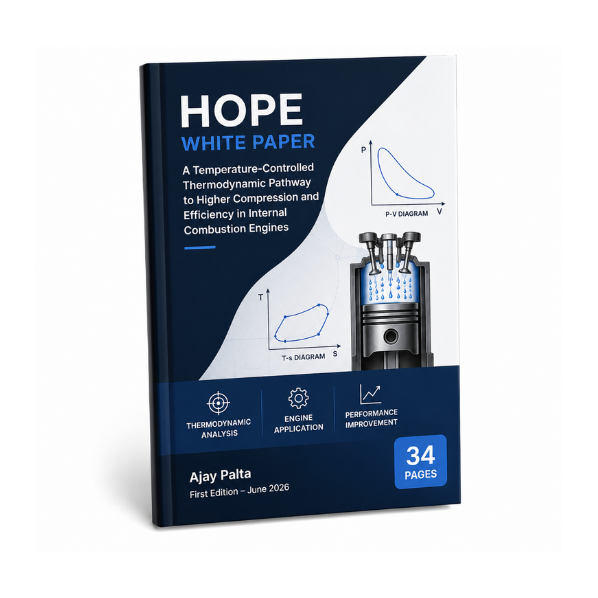
A Temperature-Controlled
Thermodynamic Pathway
to Higher Compression and Efficiency
in Internal Combustion Engines
Water is the Primary Thermodynamic
Control Variable in the HOPE Pathway
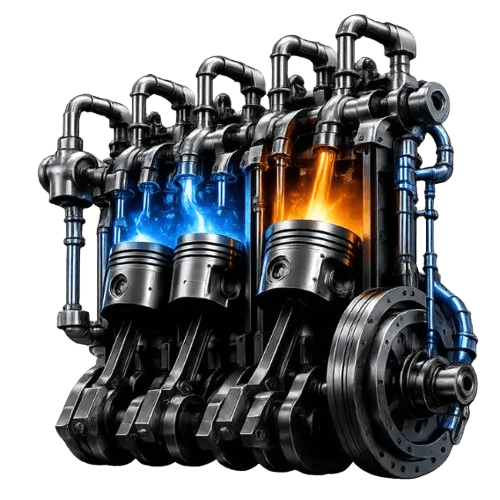
Controlled liquid water regulates temperature during compression, moderates combustion, becomes steam to add mass in expansion, and recovered heat is reused before reinjection.
Thermodynamics draws the map.
Engineering finds the path.
CONSISTENT THERMODYNAMICS
Grounded in first-principles thermodynamics.
PRACTICAL ENGINEERING
Designed for real engines and real-world constraints.
REFINED BY INSIGHT
Closed-loop control ensures cycle-to-cycle repeatability.
SUSTAINABLE BY DESIGN
More useful work from the same fuel with lower emissions.
HOW WATER CONTROLS
THE THERMODYNAMICS
Water is not just a medium.
It is the thermodynamic
control variable.
THE HOPE THERMODYNAMIC PATHWAY
Controlled Liquid Water becomes the Primary Thermodynamic Control Variable
HOPE manages temperature with water, enabling higher compression, stable combustion, steam-assisted expansion, and internal heat recovery in a closed thermodynamic loop.
COMPRESSION
(Heat Buffered by Liquid Water)
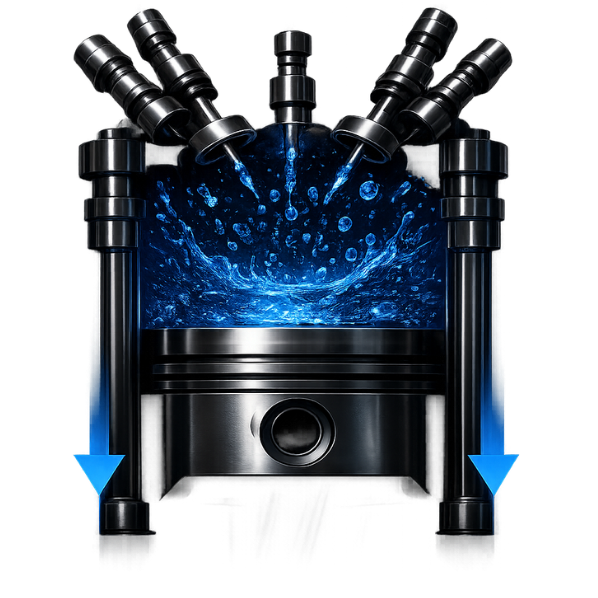
- Liquid water absorbs compression heat.
- Lowers effective compression exponent (n).
- Maintains compression temperature within knock-safe limits.
Water buffers heat during compression.
HIGHER COMPRESSION
RATIO

- Temperature is controlled by water.
- High pressure is achieved through higher compression ratio rather than excessive temperature rise.
Enables higher compression ratio without knock.
COMBUSTION
(Temperature Moderated by Phase Change)
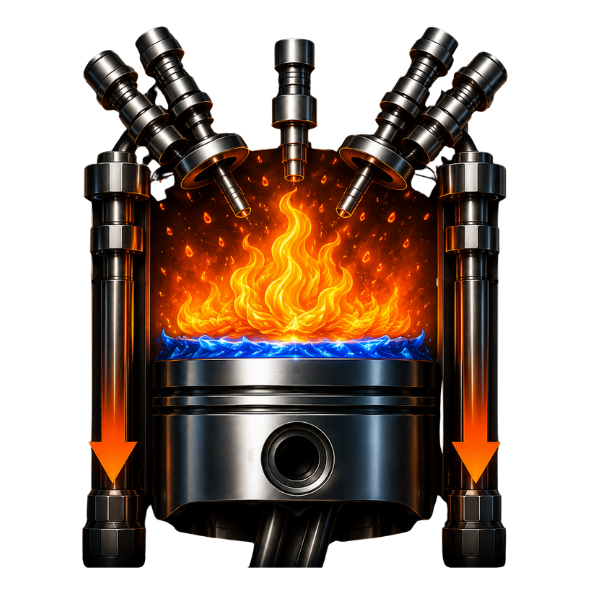
- Phase change of water moderates peak combustion temperature.
- Improves thermal control of the cycle.
- Reduces the thermodynamic tendency for high-temperature dissociation.
Phase change moderates combustion temperature and improves stability.
EXPANSION
(Steam Adds Mass)

- Water converts to steam.
- Steam generation increases working-fluid mass.
- Greater work extraction through higher effective expansion ratio.
Steam adds mass and enhances expansion work.
INTERNAL HEAT
RECOVERY
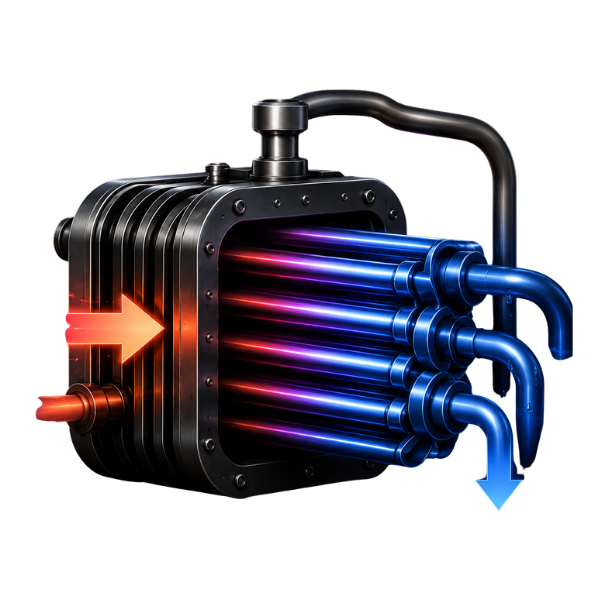
- Exhaust and cooling heat are recovered.
- Heat is transferred to the loop water.
Recovers rejected heat that would otherwise be lost.
WATER RECONDITIONING
& REINJECTION

- Recovered heat preheats the water.
- Conditioned water is re-injected for the next cycle.
- The loop continues.
Water is reconditioned and returned to the next cycle.
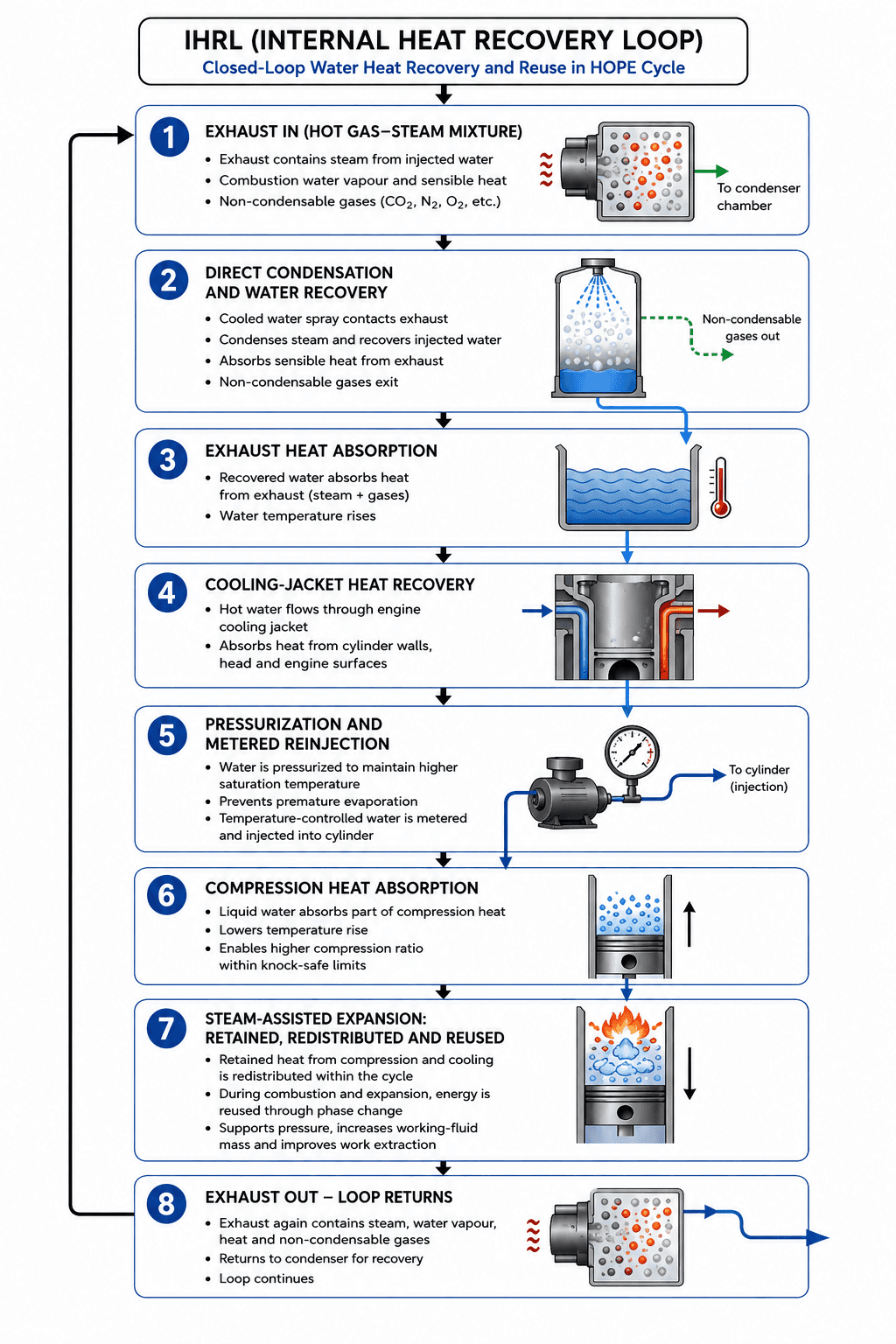
In HOPE, water is not just a medium. It is the thermodynamic control variable that governs the cycle.
HOPE FRAMEWORK – 15 SECTIONS
A Thermodynamic Framework for Higher Efficiency in Internal Combustion Engines
Core Questions
Fundamental questions that define the HOPE framework and guide the entire investigation.
Start here to understand the full picture.
Framework Overview
Purpose, direction, thermodynamic strategy and overall vision of HOPE.
HOPE vs Conventional Engines
Key differences in philosophy, operation, and energy utilization.
No-Evaporation Constraint
Why liquid water must remain in liquid phase during compression.
Role of Water
Water as a thermal mediator and co-working fluid, not a fuel.
Compression Thermodynamics
Temperature-controlled compression and its thermodynamic impact.
Combustion, Expansion & EER
Controlled combustion, expansion phase and Energy Expansion Ratio.
Pressure & Mechanical Interpretation
Pressure behavior, force transmission, and mechanical implications.
Temperature Limits & Control
Material, fluid and operational temperature limits and control strategy.
Energy Flow, Losses & IHRL
Energy distribution, losses and Internal Heat Recovery Loop (IHRL).
Efficiency & Performance
How HOPE improves efficiency and engine performance metrics.
Explorer Methodology
Modeling approach, assumptions, and known limitations.
Future Scope & Validation
Research roadmap, validation needs and real-world applications.
Abbreviations & Symbols
Complete list of abbreviations, symbols and their interpretations.
Equations & Relationships
Key equations, relationships and thermodynamic formulations.
Section 00 – Core Questions is the foundation.
It frames the problem space and connects all other sections of the HOPE Framework.
HOPE
Explorer
Interactive First-Order Thermodynamic Model for precise cycle analysis.
Contact &
Collaboration
We welcome technical discussions, independent evaluation, research collaboration and industrial engagement.
Research Collaboration
Joint research and academic collaboration
Experimental Validation
Independent testing and experimental studies
OEM & Industrial Collaboration
Co-development and technology integration
Technical Correspondence
Technical queries and information exchange
Licensing & Technology Partnerships
Licensing, IP and partnership enquiries